
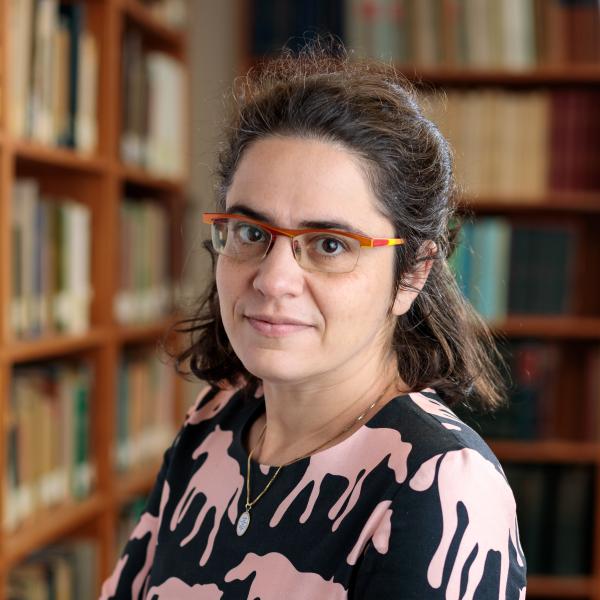
Agnes Callard is a Professor in Philosophy. She received her BA from the University of Chicago in 1997 and her PhD from Berkeley in 2008. Her primary areas of specialization are Ancient Philosophy and Ethics.
Selected Publications
Open Socrates (2025) reviewed in The New York Times, The New Yorker, The Guardian, TLS, The Washington Post, The Nation, The New Republic, Psychology Today, and The Telegraph.
Aspiration (2017); (i) reviewed in the Times Literary Supplement by Adam Bales; (ii) Reviewed in On Riding the Dragon by Katherine October Matthews; (iii) Reviewed in Philosophical Quarterly by Robert J. Hartman; (iv) reviewed in the New Yorker by Joshua Rothman; (v) reviewed in Essays in Philosophy by Krista Karbowski Thomason
“Transformative Activity in Elena Ferrante’s My Brilliant Friend,” in Transformative Experience, ed. John Schwenkler and Enoch Lambert (Oxford University Press, 2020)
"Aristotle on Deliberation," in the Routledge Handbook of Practical Reason, ed. Ruth Chang and Kurt Sylvan (2020)Ignorance and Akrasia-Denial in the Protagoras (Oxford Studies in Ancient Philosophy vol. 47)
"Enkratēs Phronimos" (Archiv für Geschichte Der Philosophie 99, no. 1, 2017)
"Everyone Desires the Good: Socrates' Protreptic Theory of Desire," Review of Metaphysics 70, no. 4 (2017)
"The Reason to Be Angry Forever," in The Moral Psychology of Anger, ed. Owen Flanagan and Myisha Cherry (2017; part of Rowman and Littlefield's Moral Psychology of the Emotions series, series editor Mark Alfano)
"Proleptic Reasons" (Oxford Studies in Meta-Ethics, vol. 11)
"The Weaker Reason" (Harvard Review of Philosophy, vol. 22)
"Liberal Education and the Possibility of Valuational Progress," Social Philosophy and Policy 34, no. 2 (2017)
Public Philosophy
(1) The Point Magazine (monthly column)
(3) Miscellaneous: Interview1, Interview2, On Meritocracy, On Utilitarianism, On Feminism, On Overthinking, On Progress in Philosophy.
Media
Agnes Callard's lectures and podcasts
Recent Courses
PHIL 26200 Intensive History of Philosophy, Part II: Aristotle
In this class, we will read selections from Aristotle's major works in metaphysics, logic, psychology and ethics. We will attempt to understand the import of his distinct contributions in all of these central areas of philosophy, and we will also work towards a synoptic view of his system as a whole. There are three questions we will keep in mind and seek to answer as readers of his treatises: (1) What questions is this passage/chapter trying to answer? (2) What is Aristotle's answer? (3) What is his argument that his answer is the correct one?
(a) If students wish to use Intensive History of Plato/Aristotle to fulfill history requirement, they must take BOTH Plato and Aristotle, and those will count only for ONE quarter of the history requirement (though they will count for 2 philosophy courses as far as the major is concerned, e.g. as electives).
(b) Students are not intending to use the courses to fulfill the history requirement, they may take Plato without Aristotle or vice versa.
PHIL 29902 Senior Seminar II
Students writing senior essays register once for PHIL 29901, in the Autumn Quarter, and once for PHIL 29902, in the Winter Quarter. The Senior Seminar meets for two quarters, and students writing essays are required to attend throughout.
Consent of Director of Undergraduate Studies. Required and only open to fourth-year students who have been accepted into the BA essay program.
PHIL 25200 Intensive History of Philosophy, Part I: Plato
In this class, we will read a number of Platonic dialogues and use them to investigate the questions with which Socrates and Plato opened the door to the practice of philosophy. Here are some examples: What does a definition consist in? What is knowledge and how can it be acquired? Why do people sometimes do and want what is bad? Is the world we sense with our five senses the real world? What is courage and how is it connected to fear? Is the soul immortal? We will devote much of our time to clearly laying out the premises of Socrates' various arguments in order to evaluate the arguments for validity.
(a) If students wish to use Intensive History of Plato/Aristotle to fulfill history requirement, they must take BOTH Plato and Aristotle, and those will count only for ONE quarter of the history requirement (though they will count for 2 philosophy courses as far as the major is concerned, e.g. as electives).
(b) Students are not intending to use the courses to fulfill the history requirement, they may take Plato without Aristotle or vice versa.
PHIL 29901 Senior Seminar I
Students writing senior essays register once for PHIL 29901, in the Autumn Quarter, and once for PHIL 29902, in the Winter Quarter. The Senior Seminar meets for two quarters, and students writing essays are required to attend throughout.
Consent of Director of Undergraduate Studies. Required and only open to fourth-year students who have been accepted into the BA essay program.
PHIL 29902 Senior Seminar II
Students writing senior essays register once for PHIL 29901, in the Autumn Quarter, and once for PHIL 29902, in the Winter Quarter. The Senior Seminar meets for two quarters, and students writing essays are required to attend throughout.
Consent of Director of Undergraduate Studies. Required and only open to fourth-year students who have been accepted into the BA essay program.
PHIL 29901 Senior Seminar I
Students writing senior essays register once for PHIL 29901, in the Autumn Quarter, and once for PHIL 29902, in the Winter Quarter. The Senior Seminar meets for two quarters, and students writing essays are required to attend throughout.
Consent of Director of Undergraduate Studies. Required and only open to fourth-year students who have been accepted into the BA essay program.
PHIL 55502 Socratic Intellectualism
We will read selections from, and secondary literature on, some early Socratic dialogues in order to engage with a set of Socratic theses on desire, motivation, and value: (1) Everyone desires the good (or: what he believes to be good?) (Meno, Gorgias, Lysis) ; (2) Everyone does what he believes (or knows?) to be best (Protagoras, Apology) (3) It is better to be wronged than to do wrong (Gorgias, Apology) (4) Only good men do wrong voluntarily (Hippias Minor) (5) Courage/Moderation is Wisdom (Laches, Protagoras, Charmides). We will want to examine these views both for consistency; for their individual merits; and in order to see whether we can put them together into a distinctively Socratic ethical point of view. (III)
PHIL 29902 Senior Seminar II
Students writing senior essays register once for PHIL 29901, in the Autumn Quarter, and once for PHIL 29902, in the Winter Quarter. The Senior Seminar meets for two quarters, and students writing essays are required to attend throughout.
Consent of Director of Undergraduate Studies. Required and only open to fourth-year students who have been accepted into the BA essay program.
PHIL 21627/31627 Modernism and the Meaning of Life
In the early part of the 20th Century, novelists from all over Europe converged on the thought that humanity was in some kind of crisis: culture had broken. In this class, we will read classics of modernist literature by James Joyce, Robert Musil, Fernando Pessoa, Virginia Woolf, Hermann Broch, Wallace Stevens, alongside philosophical and critical texts by William James, Martin Heidegger, Walter Benjamin, Georg Lukacs, Robert Pippin and others. Our goal will be to try to understand what has changed for us: what is the new problem of the meaning of life?
PHIL 29901 Senior Seminar I
Students writing senior essays register once for PHIL 29901, in the Autumn Quarter, and once for PHIL 29902, in the Winter Quarter. The Senior Seminar meets for two quarters, and students writing essays are required to attend throughout.
Consent of Director of Undergraduate Studies. Required and only open to fourth-year students who have been accepted into the BA essay program.
PHIL 21626/31626 Human Heterogeneity
People differ from one another, and some of those differences really matter—for working together, for understanding each other, and for shaping who we are. Which differences have philosophical significance, and why? This course explores both the obvious social categories—race, gender, class, culture—and the more elusive, fine-grained differences that challenge the conceit of a universal human nature. Drawing on philosophical, sociological, and literary texts, we’ll investigate how conversation can bridge (or deepen) these gaps, ultimately asking what it means to truly understand someone whose experience may be radically unlike our own.
PHIL 25105 Aristotle's Ethics
In this course, we will engage with one of the fundamental texts of practical philosophy, Aristotle’s Nicomachean Ethics. In addition to reading the text closely, we will critically discuss secondary literature, as well as contemporary attempts to revive and enlist Aristotle, with the aim of familiarizing ourselves with the work’s themes, understanding major fault lines in its interpretation, and appreciating its enduring significance. Topics to be considered include happiness and the good life, virtue, and practical reasoning. (A)
PHIL 29902 Senior Seminar II
Consent of Director of Undergraduate Studies. Required and only open to fourth-year students who have been accepted into the BA essay program.
PHIL 29901 Senior Seminar I
Students writing senior essays register once for PHIL 29901, in the Autumn Quarter, and once for PHIL 29902, in the Winter Quarter. The Senior Seminar meets for two quarters, and students writing essays are required to attend throughout.
Consent of Director of Undergraduate Studies. Required and only open to fourth-year students who have been accepted into the BA essay program.
For full list of Agnes Callard's courses back to the 2012-13 academic year, see our searchable course database.