
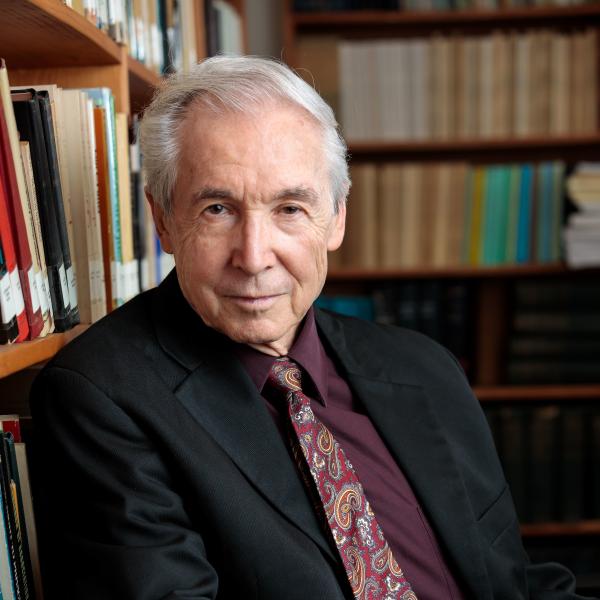
Robert J. Richards is the Morris Fishbein Distinguished Service Professor in the History of Science, and Professor in the Departments of Philosophy, History, Psychology, and in the Committee on Conceptual and Historical Studies of Science; he is director of the Morris Fishbein Center for the History of Science and Medicine. He received his degree from the University of Chicago in 1978. He does research and teaches in history and philosophy of biology and psychology. This includes particular interest in evolutionary biopsychology, ethology, sociobiology, evolutionary ethics, philosophy of history, and German Romanticism. In 2003 and again in 2011, Robert Richards received the Laing book prize from University of Chicago Press; in 2011, he received the Sarton Medal for Lifetime Achievement from the History of Science Society. He was made a Corresponding Member in Akademie der Wissenschaften zu Göttingen (2010). He is the author or editor of several books, and many articles, some of which are listed below.
Selected Publications
Debating Darwin, co-authored with Michael Ruse (Chicago: University of Chicago Press, 2016)
Was Hitler a Darwinian? Disputed Questions in the History of Evolutionary Theory (University of Chicago Press, 2013)
The Tragic Sense of Life: Ernst Haeckel and the Struggle over Evolutionary Thought (Chicago: University of Chicago Press, 2008; Paperback, 2009); 571 pp. (Winner of the University of Chicago Press Laing Prize, 2011.)
The Romantic Conception of Life: Science and Philosophy in the Age of Goethe (Chicago: University of Chicago Press, 2002). 606 pp. (Winner of the University of Chicago Press Laing Prize, 2004); paperback edition, 2004
The Meaning of Evolution: The Morphological Construction and Ideological Reconstruction of Darwin's Theory (Chicago: University of Chicago Press, 1992; paperback, 1993). 203 pp.; Spanish language edition, published by Alianza, 1998
Darwin and the Emergence of Evolutionary Theories of Mind and Behavior (Chicago: University of Chicago Press, 1987; paperback, 1989), 700 pp. (Winner of the 1988 Pfizer Prize awarded by the History of Science Society for the best book in history of science; and the prize of the Biophilosophy Form, 1989.)
Structure of Scientific Revolutions at 50, edited with Lorraine Daston (University of Chicago Press, 2016)
“Evolutionary Ethics, a Theory of Moral Realism,” in Cambridge Handbook of Evolutionary Ethics, ed. Michael Ruse and Robert J. Richards (Cambridge University Press, 2017)
"The Role of Biography in Intellectual History," KNOW, a Journal on the Formation of Knowledge 1, no. 2 (2017)
"The Impact of German Romanticism on Biology in the 19th Century," The Impact of Idealism: The Legacy in Philosophy and Science, ed. Nicholas Boyle (Cambridge University Press, 2013)
“’Nature is the Poetry of Mind,’ or How Schelling Solved Goethe’s Kantian Problems,” in Michael Friedman and Alfred Nordman (eds.), Kant and the Sciences (Boston: MIT Press, 2006
Media
Robert Richards's recorded interviews and lectures
Recent Courses
PHIL 25503 My Favorite Readings in the History and Philosophy of Science
This course introduces some of the most important and influential accounts of science to have been produced in modern times. It provides an opportunity to discover how philosophers, historians, anthropologists, and sociologists have grappled with the scientific enterprise, and to assess critically how successful their efforts have been. Authors likely include Karl Popper, Thomas Kuhn, Robert Merton, Steven Shapin, and Bruno Latour. (B)
PHIL 23405/33405 History and Philosophy of Biology
This lecture-discussion course will consider the main figures in the history of biology, from the Hippocratics and Aristotle to Darwin and Mendel. The philosophic issues will be the kinds of explanations appropriate to biology versus the other physical sciences, the status of teleological considerations, and the moral consequences for human beings. (B) (II)
PHIL 20610/30610 Goethe: Literature, Science, Philosophy
This lecture-discussion course will examine Johann Wolfgang von Goethe's intellectual development, from the time he wrote Sorrows of Young Werther through the final states of Faust. Along the way, we will read a selection of Goethe's plays, poetry, and travel literature. We will also examine his scientific work, especially his theory of color and his morphological theories. On the philosophical side, we will discuss Goethe's coming to terms with Kant (especially the latter's third Critique) and his adoption of Schelling's transcendental idealism. The theme uniting the exploration of the various works of Goethe will be unity of the artistic and scientific understanding of nature, especially as he exemplified that unity in "the eternal feminine." (B) (IV)
German would be helpful, but it is not required. Assignments: four papers (5–8 pages each).
PHIL 25503 My Favorite Readings in the History and Philosophy of Science
This course introduces some of the most important and influential accounts of science to have been produced in modern times. It provides an opportunity to discover how philosophers, historians, anthropologists, and sociologists have grappled with the scientific enterprise, and to assess critically how successful their efforts have been. Authors likely include Karl Popper, Thomas Kuhn, Robert Merton, Steven Shapin, and Bruno Latour. (B)
PHIL 23015/33015 Darwin's "On the Origin of Species" and "The Descent of Man"
This lecture-discussion class will focus on a close reading of Darwin's two classic texts. An initial class or two will explore the state of biology prior to Darwin's Beagle voyage, and then consider the development of his theories before 1859. Then we will turn to his two books. Among the topics of central concern will be the logical, epistemological, and rhetorical status of Darwin's several theories, especially his evolutionary ethics; the religious foundations of his ideas and the religious reaction to them; and the social-political consequences of his accomplishment. The year 2019 was the 210th anniversary of Darwin's birth and the 160th anniversary of the publication of On the Origin of Species. (B) (IV)
Assignments: several short papers and one long paper.
PHIL 20506/30506 Philosophy of History: Narrative and Explanation
This lecture-discussion course will focus on the nature of historical explanation and the role of narrative in providing an understanding of historical events. Among the figures considered are Gibbon, Kant, Humboldt, Ranke, Collingwood, Acton, Fraudel, Furet, Hempel, Danto. (B) (III)
PHIL 25503 My Favorite Readings in the History and Philosophy of Science
This course introduces some of the most important and influential accounts of science to have been produced in modern times. It provides an opportunity to discover how philosophers, historians, anthropologists, and sociologists have grappled with the scientific enterprise, and to assess critically how successful their efforts have been. Authors likely include Karl Popper, Thomas Kuhn, Robert Merton, Steven Shapin, and Bruno Latour. (B)
PHIL 23405/33405 History and Philosophy of Biology
This lecture-discussion course will consider the main figures in the history of biology, from the Hippocratics and Aristotle to Darwin and Mendel. The philosophic issues will be the kinds of explanations appropriate to biology versus the other physical sciences, the status of teleological considerations, and the moral consequences for human beings. (B) (II)
For full list of Robert Richards's courses back to the 2012-13 academic year, see our searchable course database.