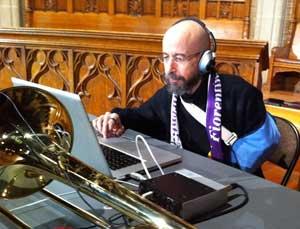
Arnold I. Davidson is the Robert O. Anderson Distinguished Service Professor in the Department of Philosophy, the Department of Comparative Literature, the Department of Romance Languages and Literatures, the Committee on the Conceptual and Historical Studies of Science, and the Divinity School. European Editor of Critical Inquiry, he is also a director of the France-Chicago Center. His major fields of research and teaching are the history of contemporary European philosophy, the history of moral and political philosophy, the history of the human sciences, and the history and philosophy of religion.
He has been a visiting professor at many French institutions (including the Collège de France, the École Normale Supérieure, the University of Paris I and the University of Paris VII) and has also been Professor of the History of Political Philosophy at the University of Pisa. Beginning in 2013, each spring he will be Visiting Professor of the Philosophy of Cultures in the Department of Philosophy and Cultural Heritage at the University Ca’Foscari of Venice. His main publications are in French and Italian as well as in English.
CV (PDF)
Arnold Davidson's recorded lectures & interviews
office: Stuart Hall 228
office hours: On Leave Spring Quarter
office phone: 773/702-9849
email: fiorentina@uchicago.edu
Please see my CV (PDF) for a complete list of publiucations.
25111/35111. Judaism and Philosophy of Religion in Contemporary Thought. (=DVPR 35111, HIJD 35111). Note: Graduate students interested in taking for credit should attend the first session before registering. How do distinctive elements in the Jewish tradition contribute to more general issues in the philosophy of religion? We will approach this question through a study of three major twentieth-century Jewish thinkers: Joseph Soloveitchik, Yeshayahu Leibowitz and Emmanuel Levinas. Topics to be discussed include the role of practice in religion, the nature of faith, the relations between ethics and law and between religion and politics, prayer and divine service, the status of tradition and sacred texts. Attention will be given both to debates within the Jewish tradition and to the framework of philosophical and theological issues that characterizes contemporary thought. Priority will be given to students with reading knowledge of French. The course will alternate between lectures and discussions. (I) Winter 2013.
50211. Models of Philosophy/Religion as a Way of Life. (=CMLT 50511, DVPR 50211, FREN 40212, HIJD 50211). PQ: Reading knowledge of French required. Limited enrollment; Students interested in taking for credit should attend 1st seminar before registering. Consent only. In the first part of this course, we will examine Stoicism as a way of life through a reading of Pierre Hadot’s commentary (in French) on Epictetus’ Manual, supplemented by other writings of Hadot. The second part of the course will be devoted to the topic of Judaism as a way of life, focusing on the writings of Joseph Soloveitchik. The third part of the course will consider a number of historically and theoretically heterogeneous essays that take up different aspects of our theme. Depending on the interests of the seminar participants, texts for this part of the course may include the writings of Francis of Assisi, essays by Michel Foucault, Hilary Putnam, and Wittgenstein’s “Lectures on Religious Belief”. (I) Autumn 2012
51990. Spiritual Exercises, Relations of Power, Practices of Freedom. (=DVPR 51990, HIJD 51990, CMLT 51990) Priority will be given to students who can read texts in French. How do ethical and political practices create new spaces of freedom? What kinds of practices can effectively modify networks of power and provoke transformations in our relations to ourselves? What is the dynamic between freedom and resistance? What forms of disobedience/dissidence/counter-conduct are ethically and politically productive? These questions will be approached through philosophical, historical, literary, and musical analysis. Readings and music may come from Pierre Hadot, Michel Foucault, Stanley Cavell, Henry David Thoreau, Ralph Waldo Emerson, Primo Levi, Martin Luther King, Jr., Derek Bailey, George Lewis, and Ceil Taylor. Autumn 2011. Syllabus
24790. Self-Transformation and Political Resistance: Michel Foucault, Pierre Hadot, Primo Levi, Martin Luther King, Jr. (=CMLT 24790, JWSC 24790) How should we understand the connections between an ethics of self-transformation and a politics of resistance to established relations of power? How are forms of the self and strategies of power intertwined? We shall examine the philosophical frameworks of Michel Foucault and Pierre Hadot with respect to these questions and then study two particular cases: Primo Levi’s account of Auschwitz and Martin Luther King Jr.’s account of the civil rights movement. We will look at the ways in which these two historically specific cases allow us to develop and test the philosophical frameworks we have examined. Autumn 2011.
21910/31910. Problems Around Foucault. (=CHSS 31910, HIPS 21910, CMLT 25102/35102, DVPR 35100) We will read some of Foucault’s most important essays and lectures, from all periods of his work, in an attempt to assess the originality and continued significance of his thought in the context of twentieth century European philosophy. We will also look at the work of other philosophers who influenced or were influenced by Foucault, for example: Georges Canguilhem, Gilles Deleuze, Paul Veyne, Pierre Hadot, Ian Hacking, etc. A final section of the course will consider how we can make use of Foucault today, with respect to questions of epistemology, politics, and ethics. Winter 2011. Syllabus
50910. Improvisation as a Way of Life. (=CDIN 50910, CMLT 51800, MUS 45511, DVPR 50901). Enrollment to be capped at 20; Graduate students interested in enrolling should email Arnold Davidson prior to registering. This seminar will be organized around the idea that the practice of improvisation is not at all limited to the artistic domain, but is a ubiquitous practice of everyday life, a primary method of exchange in any interaction. Improvisation is, in effect, a certain kind of orientation or attitude towards oneself, others, and the world. Combining philosophical, ethnographic, musicological, and technological modes of analysis and creation, this seminar aims at the presentation of new models of intelligibility, agency, expression, and social responsibility that can inform the theory and practice of real-time musical analysis, leading to new and more effective interactive technologies as well. With G. Lewis. Syllabus
21209/31209. Contemporary European Philosophy and Religion. In the first part of this course we will consider Martin Heidegger's critique of humanism and various attempts, both explicit and implicit, especially in contemporary French philosophy, to formulate alternative versions of humanism. We will study Emmanuel Levinas' conception of ethics as first philosophy and its effect on political philosophy and philosophy of religion, Jacques Derrida's politics of hospitality and cosmopolitanism, and Pierre hadot's conception of spiritual exercises and philosophy as a way of life. In the second part of this course, we will discuss the status of ethical, political, and religious concepts (and especially those concepts linked to the ideals of humanism) after the experience of Auschwitz. How should such an event affect the articulation of these concepts? The main text for this part of the course will be Primo Levi's If This is a Man(translated into English with the misleading title Survival in Auschwitz). Other readings may come from Levinas, Robert Antelme, Sara Kofman and Hans Jonas. Although all texts will be read in English, the ability to read the texts in the original languages is an advantage. Winter 2010. Syllabus
24800. Foucault and The History of Sexuality. PQ: Prior philosophy course or consent of instructor. This course centers on a close reading of the first volume of Michel Foucault’s The History of Sexuality, with some attention to his writings on the history of ancient conceptualizations of sex. How should a history of sexuality take into account scientific theories, social relations of power, and different experiences of the self? We discuss the contrasting descriptions and conceptions of sexual behavior before and after the emergence of a science of sexuality. Other writers influenced by and critical of Foucault are also discussed. Autumn 2009, Syllabus, Autumn 2012.
Twentieth-Century Continental thought: Philosophy, Theology, Literature (=PR 393/Rel 235, DivRe 415). Discussion of some major themes and figures in twentieth-century European thought. Topics for this year may include: humanism, its critique and defense (Jean-Paul Sartre, Martin Heidegger, Emmanuel Levinas, Jacques Derrida), philosophy and religion as a way of life (Pierre Hadot, Michel Foucault, Henri Bergson, Miguel de Unamuno, Lars Von Trier's Breaking the Waves in the context of the Kierkegaardean tradition), evil and the limits of moral philosophy (Maurice Blanchot, Sarah Kofman, Primo Levi, Giorgio Agamben, Roberto Beningni's Life is Beautiful, Vladimir Jankélévitch). Attention will be given to issues raised by differences in philosophical, theological, literary and cinematographic representation.
21401/31401. Philosophical Thought and Expression in Twentieth-Century Europe Open to college and grad students. Prerequisites: One prior course in philosophy.. An examination of some principal philosophical themes and figures in twentieth-century European (especially French) thought. Attention is given to the relation of philosophy, to theology, the human sciences, literature, and music. Winter 2003.
521. Historical Epistemology: Abnormality and the Self (=CFS 500; PR 507). PQ: Reading knowledge of French. The major part of this course will consist of a reading of Michel Foucault's Les Anormaux, his 1974-75 course at the Collège de France, which takes up many of the issues found in the first volume of his Histoire de la sexualité. We shall examine the emergence of the modern notion of abnormality, considering its historical background, epistemological role in the constitution of the human sciences, and political consequences. The course will begin by discussing a number of methodological issues revolving around the distinctive approach of historical epistemology, and its relation to Foucault's archaeological and genealogical analyses.
51100. Twentieth Century French Philosophy: Vladimir Jankélévitch. (=CHSS 41800, HIST 57700) PQ. Reading knowledge of French required. A study of some central texts by Vladimir Jankélévitch, one of the most significant twentieth-century French philosophers, whose major works have unfortunately not been translated into English. Texts will be drawn from Jankélévitch's writings on moral philosophy, the aesthetics of music, and metaphysics. Some attention will also be given to Jankélévitch's relation to Henri Bergson and to Emmanuel Levinas.
21202/31202. Spiritual Exercises & Moral Perfectionism. Open to college and grad students. A number of philosophers have recently proposed a new way of approaching ethics (and of reconceiveing the task of philosophy) that focuses on exercises of self-transformation and ideals of moral perfection (sometimes conceived of as forms of wisdom). A distinctive set of notions, such as spiritual exercises, practices of the self, ways of life, the aesthetics of existence, the care of the self, conversion, and moral exemplarity, is meant to displace the picture of morality as primarily a code of good conduct. We shall study three contemporary authors who are central to reviving this way of thinking about ethical practice - Pierre Hadot, Michel Foucault, and Stanley Cavell. Their work will be read against the background of some classic texts in the history of philosophy in an attempt to uncover the historical tradition and the contemporary significance of this conception of the moral life. (A) Autumn 2006.
21401/31401. Philosophical Thought and Expression in Twentieth-Century Europe. Open to college and grad students. Prerequisites: One prior course in philosophy.. An examination of some principal philosophical themes and figures in twentieth-century European (especially French) thought. Attention is given to the relation of philosophy, to theology, the human sciences, literature, and music. Winter 2003.
24800. Foucault and the History of Sexuality. Open to college students. Prerequisites: Prior philosophy course or consent of instructor. This course centers on a close reading of the first volume of Michel Foucault's The History of Sexuality, with some attention to his writings on the history of ancient conceptualizations of sex. How should a history of sexuality take into account scientific theories, social relations of power, and different experiences of the self? We discuss the contrasting descriptions and conceptions of sexual behavior before and after the emergence of a science of sexuality. Other writers influenced by and critical of Foucault are also discussed. Autumn 2005, Autumn 2007.
25401/35401. History, Philosophy and Politics of Psychoanalysis. Open to college and grad students. A reading of some central texts of Freud (both early and late) in the context of a study of the role of psychoanalysis in contemporary European philosophy. Other authors to be read may include Foucault, Deleuze and Guatteri, Marcuse, and Derrida. Winter 2002, Winter 2008.
25901/39501. Topics in Contemporary European Thought. Open to college and grad students. A study of selected authors and texts that have played a significant role in contemporary European thought. Special attention to questions of aesthetics, ethics, and politics. Winter 2006.
51101. Practices of the Self. Open to grad students. Prerequisites: Reading knowledge of French. This seminar will consist primarily of a study of Michel Foucault's 1981-82 course at the Collège de France, "L'Herméneutique du sujet," in which Foucault develops his notions of ethics and practices of the self on the basis of an interpretation of ancient, especially Hellenistic, philosophy. This text will be read against the background of the essays by Foucault, texts by Pierre Hadot, etc. Autumn 2002.
52000. Foucault: Technologies of Power. Open to grad students. Prerequisites: PQ: Reading knowledge of French. A study of Foucault's 1977-78 course Securite, Territoire, Population and the opening lecture of his 1978-79 course Naissance de la biopolitique. Securite, Territoire, Population is an analysis of the history of technologies of power from the Christian pastoral to reason of State. A crucial aspect of these courses is the development of the notion of "governmentality." Autumn 2005.
58500. French Philosophy. Open to grad students. Prerequisites: Reading knowledge of French required.. A close reading in French of Emmanuel Lévinas's Totalité et Infini. Some supplementary texts will be considered, but primarily as a way of situating Totalité et Infini within the corpus of Lévinas's work and within the history of 20th century European philosophy. Winter 2007, Autumn 2007.
58600. Workshop: Continental Philosophy. Open to grad students. Meets over three quarters. Autumn 2006, Winter 2006, Spring 2006, Autumn 2004, Winter 2007.
58702. Topics in Contemporary European Thought. Open to grad students. Prerequisites: Reading knowledge of French required. This course will focus on Pierre Hadot's Le voile d'Isis. Essai sur l'histoire de l'idée de nature. This book studies the idea of nature, from Heraclitus to Heidegger, in philosophical, theological, scientific and aesthetic contexts. At the end of the course we will read Merleau-Ponty's discussion of scientific and aesthetic perceptions of nature in Causeries, as well as a number of texts on related topics. Throughout the class we will raise methodological issues about how to write the history of philosophy. Autumn 2004.