
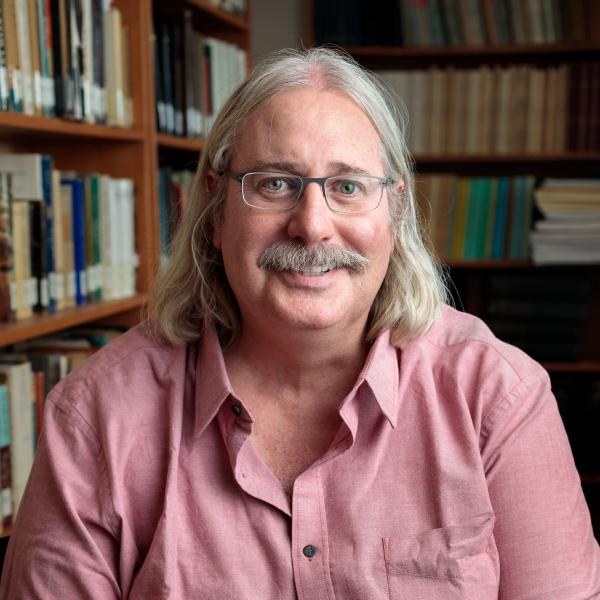
James Conant is Chester D. Tripp Distinguished Service Professor of Humanities, Professor of Philosophy, and Professor in the College at the University of Chicago. He has served as co-director of the Forschungskolleg Analytic German Idealism in Leipzig since 2012. He is also the director of the Center for German Philosophy at the University of Chicago. He received both his BA (1982) and PhD (1990) from Harvard University. He was Assistant, then Associate, and then Full Professor, over a period of nine years, at the University of Pittsburgh, before moving to Chicago in 1999. He works broadly in philosophy and has published articles in Philosophy of Language, Philosophy of Mind, Aesthetics, German Idealism, and History of Analytic Philosophy, among other areas, and on a wide range of philosophers, including Kant, Emerson, Nietzsche, Kierkegaard, Josiah Royce, William James, Frege, Carnap, Wittgenstein, Putnam, Cavell, Rorty, and McDowell, among others. He is currently working on four book-length projects: a monograph on skepticism entitled Varieties of Skepticism, a co-authored collection of essays with Cora Diamond entitled Wittgenstein and the Inheritance of Philosophy, a book on film aesthetics entitled The Ontology of the Cinematographic Image, and a forthcoming collection of interpretative essays on a variety of philosophers entitled Resolute Readings. He has edited, among other things, two volumes of Hilary Putnam's papers and co-edited (with John Haugeland) one volume of Thomas Kuhn's papers, with a second posthumous work by Kuhn soon to be completed. Together with Jay Elliot, he is about to bring out the volume of the Norton Anthology of Philosophy on The Analytic Tradition.
He has taught as a visiting professor at the College de France, Postdam University, the LMU in Munich, University of Amsterdam, University of Bergen, University of Helsinki, University of Iceland in Reykyavik, University of Picardy in Amiens, University of Uppsala, Leipzig University, Göttingen University, University College Dublin, University of Veracruz in Xalapa, Humboldt University in Berlin, and the University of Rome La Sapienza. From 1990 to 1993 he was a Fellow at the Michigan Society of Fellows, from 2008 to 2009 at the Wissenschaftskolleg zu Berlin, and from 2012 to 2013 at the Lichtenberg-Kolleg of the University of Goettingen. From 2006 to 2008, together with David Wellbery, he was a co-recipient of a Mellon Foundation Saywer Seminar Grant. He is the co-recipient of two Humboldt TransCoop Awards, one with Sebastian Rödl and one with Pirmin Stekeler, each of which has facilitated numerous philosophical projects, workshops, and conferences sponsored jointly by the Departments of Philosophy at Leipzig University and the University of Chicago. In 2012 he was awarded the Anneliese Meier Prize by the Humboldt Foundation. In 2016, Conant was one of three academics from abroad selected to receive Germany’s top international research award, the Alexander von Humboldt Professorship Research Prize.
He serves on a number of academic advisory boards, including those of the Wissenschaftskolleg zu Berlin, the Kulturwissenschaftliches Institut Essen, the Berlin Center for Knowledge Research, the North American Nietzsche Society, the Wittgenstein Initiative, and the Internationale Ludwig Wittgenstein Gesellschaft. He is also a member of the senior editorial board of the bi-lingual German-English journal Wittgenstein-Studien: Internationales Jahrbuch für Wittgenstein-Forschung and the senior editorial board of the bi-lingual Italian-English journal Iride. Together with Günter Abel, he is co-editor of the book series Berlin Studies in Knowledge Research, as well as a member of the advisory board of the book series called Nordic Wittgenstein Studies.Together with Andrea Kern, he is the co-director of the Center for Analytic German Idealism and co-editor of the affiliated book series Analytischer Deutscher Idealismus. He served as Chair of the Department of Philosophy at the University of Chicago for three years, stepping down in July 2011, and serving again as Interim Chair for the academic years 2014-15 and 2025-26.
Selected Publications
James Conant “Wittgenstein’s Critique of the Additive Conception of Language,” in Nordic Wittgenstein Review, 9, 2020.
The Logical Alien, published by Harvard University Press in February 2020, contains an opening essay by James Conant, eight critical essays on Conant by leading philosophers, and fourteen further essays by James Conant, eight of which are essay-length replies to each of his critics.
“Some Socratic Aspects of Wittgenstein’s Conception of Philosophy,” in Wittgenstein on Philosophy, Objectivity, and Meaning, ed. J. Conant & S. Sunday (Cambridge: Cambridge University Press, 2019), pp. 231-64.
“Why Kant Is Not a Kantian,“ Philosophical Topics 44, no. 1 (Spring 2016)
“Two Varieties of Skepticism,” in Rethinking Epistemology, vol. 2, edited by Guenter Abel and James Conant (Berlin: Walter De Gruyter, 2012)
“Three Ways of Inheriting Austin,” in La philosophie du langage ordinaire: Histoire et actualité de la philosophie d’Oxford / Ordinary Language Philosophy: The History and Contemporary Relevance of Oxford Philosophy, ed. Christoph Al-Saleh and Sandra Laugier (Olms Verlag, Hildesheim, 2011)
"Wittgenstein’s Methods," in The Oxford Handbook of Wittgenstein, ed. O. Kuusela and M. McGinn (Oxford University Press, Oxford, 2011)
“Wittgenstein’s Later Criticism of the Tractatus,” in Wittgenstein: The Philosopher and his Works, ed. A. Pichler and S. Säätelä (Ontos Verlag, 2006)
“The Dialectic of Perspectivism, I,” SATS, Autumn 2005 issue
“The Dialectic of Perspectivism, II,” SATS, Spring 2006 issue
“Rorty and Orwell on Truth,” in On Nineteen Eighty-Four: Orwell and the Future, ed. Abbot Gleason, Jack Goldsmith, and Martha Nussbaum (Princeton, NJ: Princeton University Press, 2005)
"The Method of the Tractatus," in From Frege to Wittgenstein: Perspectives on Early Analytic Philosophy, ed. Erich H. Reck, (Oxford University Press, 2002)
"Nietzsche's Perfectionism: A Reading of Schopenhauer as Educator," in Nietzsche’s Postmoralism, ed. Richard Schacht (Cambridge University Press, 2000)
"The Search for Logically Alien Thought: Descartes, Kant, Frege and the Tractatus," in The Philosophy of Hilary Putnam, Philosophical Topics, vol. 20, no. 1, pp. 115-180.
Further Publications and Materials
To see a more comprehensive list of publications, please visit Jim Conant's personal webpage here.
Media
James Conant's recorded interviews, lectures, etc.
Interview with James Conant on “Talking to Thinkers” by Johnny Lyons. Part 1, Part 2
James Conant, Allan Janik, Ray Monk, and David Stern discuss Christian Erbacher’s “Wittgenstein’s Heirs and Editors.” YouTube Link
Philosophy Voiced: Podcast with Cora Diamond and James Conant. April 18, 2019
Audio Recordins of Intensive Seminar with James Conant and Cora Diamond at the University of Pardubice, October, 2018.
Cora Diamonds Session: Truth in Ethics;
James Conant’s Session: Socrates and Wittgenstein
Joint Session: Cora Diamond and James Conant
Recent Courses
PHIL 53540 The Problem of Other Minds
This course will explore the problem of other minds, beginning with a comparison of this problem with others to which it is sometimes thought to be closely related. Our first object of comparison in this regard will be with the problem of our knowledge of the external world. We will explore supposed similarities and differences between other minds and external world skepticism and between various philosophical responses to each. The main asymmetry between these two problems is often held to lie in the idea the that knowing another mind is a matter of knowing a special kind of content. (Human beings are not mere objects. When one knows another mind, one knows a formally distinct kind of object than a mere material thing.) We will also explore the idea that the most fundamental difference between the two problems lies not merely in the content but in the form of the knowledge. This requires treating the problem of other minds as one whose solution requires attention to the second person form—one in which, in the paradigmatic case, two subjects are known to each other. In this connection, we will explore a variety of forms of nexus—linguistic, epistemological, and ethical—in which a pair of subjects can stand in a reciprocal recognitive relation to one another. The primary readings for the course will be from Elizabeth Anscombe, Anita Avramides, Stanley Cavell, John Cook, Vincent Descombes, Martin Gustafsson, Jennifer Hornsby, John McDowell, Richard Moran, and Ludwig Wittgenstein. (II)
PHIL 51833 Wittgenstein and Moore’s Paradox
Wittgenstein wrote a letter to G. E. Moore after hearing Moore give the paper which first set forth a version of (what has come to be known as) Moore’s paradox. The version of the paradox that Moore first set forward involved imagining someone uttering the following sentence: “There is a fire in this room and I don’t believe there is.” Wittgenstein’s understanding of the importance of Moore’s paradox may be summarized as follows: Something on the order of a logical contradiction arises when we attempt to combine the affirmation of p and a denial of a consciousness of p within the scope of a single judgment. In his letter to Moore, Wittgenstein writes:
To call this … “an absurdity for psychological reasons” seems to me to be wrong, or highly misleading. It … is in fact something similar to a contradiction, though it isn’t one…. This means roughly: it plays a similar role in logic. You have said something about the logic of assertion. Viz: It makes sense to say “Let’s suppose: p is the case and I don’t believe that p is the case,” whereas it makes no sense to assert “p is the case and I don’t believe that p is the case.” This assertion has to be ruled out and is ruled out by “common sense,” just as a contradiction is. And this just shows that logic isn’t as simple as logicians think it is. In particular: that contradiction isn’t the unique thing people think it is. It isn’t the only logically inadmissible form.
The aim of the seminar is to understand why Wittgenstein thinks Moore’s paradox provides an example of something that is akin to a contradiction and how it brings out why logic isn’t as simple as logicians think it is. In Section x of Part II of Wittgenstein’s Philosophical Investigations, devoted to an exploration of Moore’s paradox, we find Wittgenstein making these three remarks:
- My own relation to my words is wholly different to other people’s.
- If there were a verb meaning ‘to believe falsely,’ it would not have a meaningful first-person present indicative.
- “I believe….” throws light on my state. Conclusions about my conduct can be drawn from this expression. So there is a similarity here to expressions of emotion, of mood, etc,.
The workshop will seek to understand: how my relation to my own words is wholly different from my relation to those of other people; wherein the asymmetry lies between the use of a range of verbs (such as “believe,” “know,” and “perceive”) in the first-person present indicative form and other uses of the same verbs (e.g., in the second-person or past tense form); and how the logical grammar of these verbs is related to that of expressions of emotion, of mood, and of sensation, including expressions that takes the form of avowals. Finally, we will explore why Wittgenstein thinks a philosophical investigation of these three points ought to lead to an expansion and transformation of our entire conception of logic
In addition to readings by Moore, Wittgenstein, and related secondary literature, we will study thematically related writings by Matthew Boyle, Cora Diamond, Arata Hamawaki, Jonas Held, Michael Kremer, J. M. E. Mactaggart, Margaret MacDonald, Norman Malcolm, Marie McGinn, Eric Marcus, Richard Moran, Bertrand Russell, and Crispin Wright on first-person avowals, self-knowledge, self-alienation, and transparency. (II)
PHIL 21511/31511 Forms of Philosophical Skepticism
The aim of the course will be to consider some of the most influential treatments of skepticism in the post-war analytic philosophical tradition—in relation both to the broader history of philosophy and to current tendencies in contemporary analytic philosophy. The first part of the course will begin by distinguishing two broad varieties of skepticism—Cartesian and Kantian—and their evolution over the past two centuries (students without any prior familiarity with both Descartes and Kant will be at a significant disadvantage here), and will go on to isolate and explore some of the most significant variants of each of these varieties in recent analytic philosophy. The second part of the course will involve a close look at recent influential analytic treatments of skepticism. It will also involve a brief look at various versions of contextualism with regard to epistemological claims. We will carefully read and critically evaluate writings on skepticism by the following authors: J. L. Austin, Robert Brandom, Stanley Cavell, Thompson Clarke, Saul Kripke, C. I. Lewis, John McDowell, H. H. Price, Hilary Putnam, Barry Stroud, Charles Travis, Michael Williams, and Ludwig Wittgenstein. (B) (II)
This will be an advanced lecture course open to graduate students and undergraduates with a prior background in analytic philosophy.
PHIL 58009 Disjunctivism and the Philosophy of Language
Disjunctivist accounts of human capacities always turn on some form of rejection of (what we will call in this course) a layer-cake assumption. One particularly widespread version of the latter sort of assumption, when asserted as a thesis about the nature of our cognitive faculties and their relation to one another, goes like this: The natures of our sentient and rational capacities respectively are such that we could possess one of these capacities, as a form of cognition, without possessing the other. The underlying assumption is that at least one of these capacities is a self-standing cognitive capacity – one which could operate just as it presently does in us in isolation of the other. This course will begin by examining the counterpart assumption in the philosophy of language, when it is asserted as a thesis about the relation between the aspects of language we respectively apprehend through our power of sensory perception (for example, in recognizing signs) and through our power of intellectual comprehension (for example, in grasping a meaning). One tendency, for example, which we find in much contemporary philosophy of language is to conceive of the linguistic expression as a composite notion to be analyzed in terms of a kind of mere physical mark or acoustic noise to which something further — a meaning or use — is assigned or added in order to yield a fully linguistic expression. Some of the more penetrating philosophers of the past century have noticed that such a conception of language (once it is strictly thought through) appears to encounter insurmountable difficulties. This course will begin by looking at the work of some thinkers in the history of philosophy and linguistics who have challenged such a conception. We will then move on to considering further varieties of layer-cake assumptions and disjunctivist responses thereto that arise in the philosophy of language pertaining to the following further ten interrelated topics: (1) the relation between phonetics and phonology, (2) the relation between phonemes and morphemes, (3) between words and sentences, (4) between infant and adult forms of linguistic capacity, (5) between first and second language acquisition, (6) between orality and literacy in the cultural phases of the historical development of a single natural language, (7) between the pre- and post-punctuation phases in the historical development of the written form of a modern natural language, (8) between the written and spoken sign forms within a single modern natural language, (9) between a logically regimented artificial sign system and a living natural language, and (10) between diverse linguistic forms of speech and/or writing within a single cultural form of life marked by diglossia or heteroglossia. (II)
PHIL 22277/32277 The Philosophy of Thomas Kuhn
Thomas Kuhn was both an historian and a philosopher of science, with broader interests in philosophical issues pertaining to the nature of language, truth and knowledge — and, in particular, pertaining to questions concerning the possibility of communicability, commensurability, and inter-translatability across radically divergent conceptual schemes, theoretical frameworks, or grammatical/ linguistic structures. This course will be devoted to a close examination of the treatment of these topics in Kuhn’s work. For purposes of orientation, we will begin with several class meetings in which we read his classic work The Structure of Scientific Revolutions, first published in 1962, along with some the central texts which figured in the controversies that book ignited in connection with the aforementioned topics. We will then examine some of the second thoughts Kuhn himself expressed concerning that work in scattered essays written between 1969 and 1977 (some of which are collected in The Essential Tension). The second half of the course will be on Kuhn’s work from 1978 until his death in 1996, starting with the essays collected in The Road Since “Structure", and further developed in The Presence of Science Past (his 1987 Shearman Lectures) and The Plurality of Worlds (his final unfinished magnum opus). (B) (II)
PHIL 27506/37506 The Second Person: Theoretical and Practical Perspectives
The ‘I think’ traditionally stands at the center of philosophical reflection. Yet there is a minority strand in the history of philosophy which has advocated that the second person pronoun is no less central. Human beings are social creatures. For this reason, addressing another as ‘you’ in communication is no less fundamental to human rationality than giving expression to oneself through saying ‘I.’ A guiding idea of the proposed seminar will be that, properly conceived, self-consciousness and recognition of another are two sides of one and the same phenomenon. In seeking to make out this claim, the seminar will explore the different aspects of the role of address in human life. It will take its point of departure from two guiding ideas: (1) the second-person present indicative form of interpersonal nexus is no less important for understanding human thought and action and logically no less fundamental than the corresponding first-person form, and (2) what is logically peculiar to the former form of thought is best brought to the fore if one examines what second-person thought in both its theoretical and practical guises have in common. The plan for the seminar is to alternate between examining problems in theoretical philosophy whose proper solution requires attention to the role of the second person and counterpart sorts of problem in practical philosophy. Under the first heading, we will explore the role of address and joint consciousness in speech act theory, the topic of shared understanding in the philosophy of language acquisition, and the problem of the apprehension of another human being as it arises in the epistemology of other minds. Interpolated between these topics, we will weave in and out of counterpart forms of philosophical difficulty arising out of reflection upon the place of the second-person in practical philosophy: in understanding the human striving for honor, in relations of justice, as well as in friendship and love. (I) (II)
At least one course in philosophy.
PHIL 20625/30625 Sign and Symbol
The tendency in contemporary philosophy is to conceive of a linguistic sign as a composite notion to be analyzed in terms of kind of mere physical mark or acoustic noise to which something further — a meaning or use — is assigned or added in order yield a meaningful linguistic symbol. This course will explore figures in the history of philosophy and linguistics who opposed such a conception – figures, that is, who thought that the capacity to recognize linguistic signs presupposes some prior comprehension of their real possibilities of use. Readings will be from Frege, Hilbert, early and later Wittgenstein, Franz Boas, Roman Jacobson, Morris Halle, David Kaplan, Sylvan Bromberger, and others. (B) (I)
One previous course in philosophy.
PHIL 50128 Logic-Mathematical vs. Logico-Philosophical Conceptions of Logic
The history of philosophy, from antiquity to the early twentieth century, is littered with classic works bearing titles such as The Principles of Logic, The Foundations of Logic, A Theory of Logic, and so on. Most of the major philosophers in this tradition – Aristotle, Avicenna, Leibniz, Kant, Hegel, etc. – devote at least one whole treatise to Logic, and in most cases several. These works are, like their other writings, composed of sentences – sentences of Greek, Arabic, Latin or German prose. The object of such works is to elucidate notions such as thought, judgment, negation, inference, and inquiry. Starting in the late 19th- and early 20th century a new kind of work in the theory of logic appeared – published by authors such as Boole, Peano, Frege, Russell, Hilbert, etc. These works contained comparatively little prose and a great many quasi-mathematical symbols in which formulae, axioms, theorems, proofs, etc. were set forward. The latter sorts of work had an enormous influence on how the nature of the discipline of logic itself came to be understood and how its relation, on the hand, to mathematics, and, on the other, to the rest of philosophy, came to be re-conceived. This, in turn, led – through the work of authors such as Ludwig Wittgenstein, J. L. Austin, Gilbert Ryle, Peter Strawson, etc. – to a series of efforts to challenge the ascendancy of the logico-mathematical conception of logic. The seminar will explore the relation between these two different conceptions of logic. We will be interested in ways in which these conceptions, at least in the hands of some authors, were carved out in a manner that allowed them at least to appear to coincide with one another, as well as ways in which they either tacitly diverged or openly conflicted with one another. The ideas set forth in two works by Wittgenstein – his early Tractatus and his later Remarks on the Foundations of Mathematics – will shape our approach to these issues. The readings for the course will include canonical texts from the classic tradition of thought about logic from Aristotle through Kant and beyond, as well as targeted selections from those of Wittgenstein’s contemporaries whom he is most concerned to criticize (especially Frege, Russell, and Hilbert). The seminar will also feature various sidelong glances at parallel developments in the Continental tradition in authors such as Husserl, Heidegger, Jakob Klein, and others. (III)
Philosophy graduate students: no pre-reqs; all others: permission of the instructor.
PHIL 50124 Wittgenstein’s Treatment of Rule Following in Remarks on the Foundations of Mathematics and Philosophical Investigations
This course will involve a close reading of the sections devoted to the topic of rule following in two of Wittgenstein’s best known later writings, Remarks on the Foundations of Mathematics and Philosophical Investigations, as well an examination of some of the most influential secondary literature on those sections, including texts by Brandom, Bridges, Diamond, Dummett, Finkelstein, Floyd, Goldfarb, Kripke, McDowell, Stroud, and Wright. (III)
Open only to graduate students.
For full list of Jim Conant's courses back to the 2012-13 academic year, see our searchable course database.