
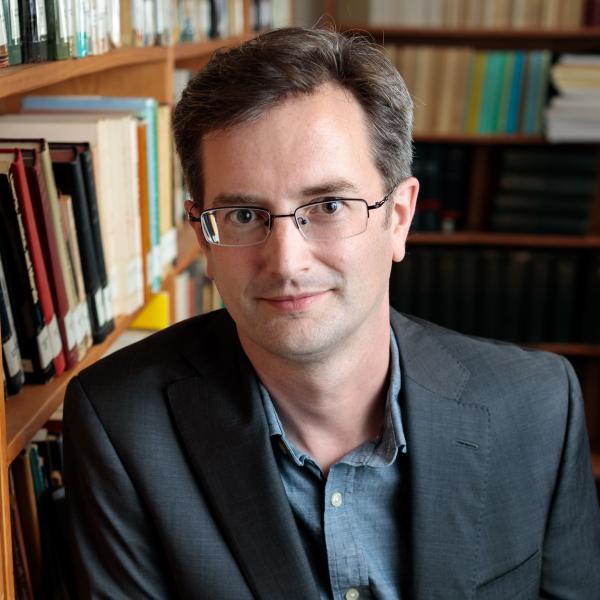
Benjamin Callard is an Instructional Professor in Philosophy. He received his BA from Brandeis, his MA from Tufts, and his PhD (2007) from Berkeley. Ben’s areas of specialization are ethics, metaphysics, and epistemology. He also has strong interests in the philosophy of mathematics, the philosophy of mind, and the philosophy of language.
Selected Publications
“Who Proved the Independence of the Continuum Hypothesis?” (co-author Palle Yourgrau) Annals of Mathematics and Philosophy, April 2025
“Can Math Move Matter?” Inquiry, October 2018
“The Conceivability of Platonism,” Philosophia Mathematica 15, no. 3 (October 2007): 347-356
Recent News
Ben discussed authenticity with Parsons School of Design professor of fashion Fiona Dieffenbacher at an event sponsored by the Veritas Forum in Spring Quarter 2022, presented a new solution to the problem of induction at UChicago's Night of Ideas conference in Winter Quarter 2023, and debated neuroscientist Jonas Kaplan (USC) at an event organized by the Chicago Debate Society in Winter Quarter 2024.
Recent Courses
PHIL 20119 Introduction to Wittgenstein
This course is an introduction to the central ideas of Wittgenstein--in philosophy of language, philosophy of mathematics and logic, philosophy of mind, epistemology, philosophy of religion, metaphilosophy, and other areas of the subject. We will attempt to understand, and to evaluate, these ideas. As part of this attempt, we will explore Wittgenstein’s relation to various others figures—among them Hume, Schopenhauer, Frege, and the logical positivists. (B)
PHIL 23000 Introduction to Metaphysics and Epistemology
In this course we will explore some of the central questions in epistemology and metaphysics. In epistemology, these questions will include: What is knowledge? What facts or states justify a belief? How can the threat of skepticism be adequately answered? How do we know what we (seem to) know about mathematics and morality? In metaphysics, these questions will include: What is time? What is the best account of personal identity across time? Do we have free will? We will also discuss how the construction of a theory of knowledge ought to relate to the construction of a metaphysical theory-roughly speaking, what comes first, epistemology or metaphysics? (B)
PHIL 25120 Introduction to Philosophy of Religion
This course explores the Western philosophical tradition of reasoned reflection on religious belief. Our questions will include: what are the most important arguments for, and against, belief in God? How does religious belief relate to the deliverances of the sciences, in particular to evolutionary theory? How can we reconcile religious belief with the existence of evil? What is the relationship between religion and morality? In attempting to answer these questions we will read work by Plato, Augustine, Anselm, Nietszche, and Freud, as well as some recent texts. (B)
PHIL 31414 MAPH Core Course: Contemporary Analytic Philosophy
This course is designed to provide MAPH students – especially those interested in pursuing a Ph.D. in Philosophy – with an introduction to some recent debates between philosophers working in the analytic tradition. The course is, however, neither a history of analytic philosophy nor an overview of the discipline as it currently stands. The point of the course is primarily to introduce the distinctive style and method – or styles and methods – of philosophizing in the analytic tradition, through brief explorations of some currently hotly debated topics in the field.
This course is open only to MAPH students. MAPH students who wish to apply to Ph.D. programs in Philosophy are strongly urged to take this course.
PHIL 29906/39906 The Philosophy of Artificial Intelligence: Mind and Model
What can reflection upon artificial intelligence teach us about human thought? This question may be asked and understood in many ways. Our concern will be philosophical: the insight we seek is into the nature and structure of thought as it is for the one thinking, as it informs, shapes, or constitutes the life of a thinking being. This course will lay the groundwork for pursuit of our question by (1) introducing and examining the idea of a model of a human intellectual capacity (2) outlining the basic concepts needed for understanding the architecture of the currently most noteworthy form of artificial intelligence—the class of language models known as GPTs, (3) introducing some of the philosophical ideas needed for analyzing the forms of thought that go into human linguistic communication, and finally (4) endeavoring to bring all of these elements together. (B)
While some of the philosophical readings are challenging, prior familiarity with philosophy is not a prerequisite.
PHIL 21000 Introduction to Ethics
An exploration of some of the central questions in metaethics, moral theory, and applied ethics. These questions include the following: are there objective moral truths, as there are (as it seems) objective scientific truths? If so, how can we come to know these truths? Should we make the world as good as we can, or are there moral constraints on what we can do that are not a function of the consequences of our actions? Is the best life a maximally moral life? What distribution of goods in a society satisfies the demands of justice? Can beliefs and desires be immoral, or only actions? What is “moral luck”? What is courage? (A)
PHIL 21114/31114 Philosophy of Logic
Logic is, and always has been, a branch of philosophy. Why? What is logic? In this course we will explore the nature of logic, and how it relates to thought; to reasoning; to ordinary language; to mathematics; and to philosophy. We will read texts on the subject of logic by Aristotle, Kant, Hegel, Frege, Russell, Wittgenstein, Quine, Black, Prior, Gödel, Kripke, Dummett, Boolos, Putnam, Benacerraf, Harman, Williamson, Priest, and others. The course will be completely non-technical: we will be trying to make philosophical sense of logic. (B)
PHIL 23000 Introduction to Metaphysics and Epistemology
In this course we will explore some of the central questions in epistemology and metaphysics. In epistemology, these questions will include: What is knowledge? What facts or states justify a belief? How can the threat of skepticism be adequately answered? How do we know what we (seem to) know about mathematics and morality? In metaphysics, these questions will include: What is time? What is the best account of personal identity across time? Do we have free will? We will also discuss how the construction of a theory of knowledge ought to relate to the construction of a metaphysical theory-roughly speaking, what comes first, epistemology or metaphysics? (B)
PHIL 28010 Introduction to Philosophy of Language
An introduction to philosophical thought about the nature of language. The questions we will address include: What is meaning? What is truth? How does language relate to thought? How do languages relate to each other? What is metaphor? What is fiction? The focus will be on classic work in the analytic tradition (Frege, Russell, Wittgenstein, Carnap, Tarski, Quine, Austin, Grice, Davidson, Donnellan, Putnam, Searle, Kaplan, Kripke) but we will also read, and relate to this modern work, some current work in the philosophical literature and some seminal discussions of language in the writings of Plato and Aristotle. (B)
PHIL 23000 Introduction to Metaphysics and Epistemology
In this course we will explore some of the central questions in epistemology and metaphysics. In epistemology, these questions will include: What is knowledge? What facts or states justify a belief? How can the threat of skepticism be adequately answered? How do we know what we (seem to) know about mathematics and morality? In metaphysics, these questions will include: What is time? What is the best account of personal identity across time? Do we have free will? We will also discuss how the construction of a theory of knowledge ought to relate to the construction of a metaphysical theory-roughly speaking, what comes first, epistemology or metaphysics? (B)
PHIL 23001 Paradoxes
Paradoxes are conflicts in our own thought. Many of the most fundamental, frustrating, disturbing, and exciting concerns in philosophy and the sciences are to be found where paradoxes arise. In this course we will investigate paradoxes in logic, in metaphysics, in ethics, in action theory, in epistemology, and elsewhere. We will also try to understand the nature and sources of paradox—since the very possibility of paradoxes is, itself, a paradox. (B)
PHIL 25120 Introduction to Philosophy of Religion
This course explores the Western philosophical tradition of reasoned reflection on religious belief. Our questions will include: what are the most important arguments for, and against, belief in God? How does religious belief relate to the deliverances of the sciences, in particular to evolutionary theory? How can we reconcile religious belief with the existence of evil? What is the relationship between religion and morality? In attempting to answer these questions we will read work by Plato, Augustine, Anselm, Nietszche, and Freud, as well as some recent texts. (B)
PHIL 29601 Intensive Track Seminar
Title: Philosophy and Fiction
In this course we will try to make sense of fiction using the techniques of philosophy. What is the ‘logic’ of fictional discourse? What makes a work, a work of fiction? (Is it the intentions of the author?) What is the metaphysical status of fictional characters? How does the making and consuming of fiction relate to other practices in human life—for example, playing games and lying? How can we be emotionally affected by fiction when we know it is fiction? We will read a variety of texts on these subjects, but the focus will be on work in the analytic tradition.
Open only to third-year students who have been admitted to the intensive track program.
PHIL 21000 Introduction to Ethics
An exploration of some of the central questions in metaethics, moral theory, and applied ethics. These questions include the following: are there objective moral truths, as there are (as it seems) objective scientific truths? If so, how can we come to know these truths? Should we make the world as good as we can, or are there moral constraints on what we can do that are not a function of the consequences of our actions? Is the best life a maximally moral life? What distribution of goods in a society satisfies the demands of justice? Can beliefs and desires be immoral, or only actions? What is “moral luck”? What is courage? (A)
PHIL 21214 The Philosophy of Art
This course is an introduction to the philosophy of aesthetics, with a focus on art and art objects. With respect to art, our questions will include: What is art? What is the point of making art? What is it to appreciate art? (Does discursive knowledge (of the technique, the history of the painting or its subjects, the artist’s life, etc.) help or hinder this appreciation?) What is the metaphysical character of art objects (symphonies, paintings, novels, etc.)? What is the ethical status of art? (Were Plato’s ethical suspicions about art warranted?) With respect to aesthetics more generally, our questions will include: is beauty in the eye of the beholder? (What is it for something to be in the eye of the beholder?) Does beauty track (or even constitute) scientific truth? If so: why? If not, why have so many mathematicians, physicists, and biologists been preoccupied with the beauty of their theories?
PHIL 21726 The Mind/Body Problem
What are minds, what are bodies, and what is the relation between minds and bodies? The reason these questions represent a problem is that a. the questions are of fundamental significance but that b. no answer to them is easy to defend. In this course we will try to understand this problem, and to arrive at some answers. To help us toward this goal we will read important philosophical work on the subject--some older writings (Plato, Aristotle, Descartes, Hume), but with a focus on work in the last eighty years (including Wittgenstein, Ryle, Anscombe, Davidson, Smart, Place, Armstrong, Kripke, Putnam, Searle, Lewis, Nagel, Dennett, Dretske, The Churchlands, Jackson, McGinn, Block, Kim, Chalmers).
PHIL 28010 Introduction to Philosophy of Language
An introduction to philosophical thought about the nature of language. The questions we will address include: What is meaning? What is truth? How does language relate to thought? How do languages relate to each other? What is metaphor? What is fiction? The focus will be on classic work in the analytic tradition (Frege, Russell, Wittgenstein, Carnap, Tarski, Quine, Austin, Grice, Davidson, Donnellan, Putnam, Searle, Kaplan, Kripke) but we will also read, and relate to this modern work, some current work in the philosophical literature and some seminal discussions of language in the writings of Plato and Aristotle.
PHIL 20119 Introduction to Wittgenstein
This course is an introduction to the central ideas of Wittgenstein--in philosophy of language, philosophy of mathematics and logic, philosophy of mind, epistemology, philosophy of religion, metaphilosophy, and other areas of the subject. We will attempt to understand, and to evaluate, these ideas. As part of this attempt, we will explore Wittgenstein’s relation to various others figures—among them Hume, Schopenhauer, Frege, and the logical positivists. (B)
PHIL 23000 Introduction to Metaphysics and Epistemology
In this course we will explore some of the central questions in epistemology and metaphysics. In epistemology, these questions will include: What is knowledge? What facts or states justify a belief? How can the threat of skepticism be adequately answered? How do we know what we (seem to) know about mathematics and morality? In metaphysics, these questions will include: What is time? What is the best account of personal identity across time? Do we have free will? We will also discuss how the construction of a theory of knowledge ought to relate to the construction of a metaphysical theory-roughly speaking, what comes first, epistemology or metaphysics? (B)
PHIL 21000 Introduction to Ethics
An exploration of some of the central questions in metaethics, moral theory, and applied ethics. These questions include the following: are there objective moral truths, as there are (as it seems) objective scientific truths? If so, how can we come to know these truths? Should we make the world as good as we can, or are there moral constraints on what we can do that are not a function of the consequences of our actions? Is the best life a maximally moral life? What distribution of goods in a society satisfies the demands of justice? Can beliefs and desires be immoral, or only actions? What is “moral luck”? What is courage? (A)
PHIL 29601 Intensive Track Seminar
Title: Philosophy and Fiction
In this course we will try to make sense of fiction using the techniques of philosophy. What is the ‘logic’ of fictional discourse? What makes a work, a work of fiction? (Is it the intentions of the author?) What is the metaphysical status of fictional characters? How does the making and consuming of fiction relate to other practices in human life—for example, playing games and lying? How can we be emotionally affected by fiction when we know it is fiction? We will read a variety of texts on these subjects, but the focus will be on work in the analytic tradition.
Open only to third-year students who have been admitted to the intensive track program.
For full list of Ben Callard's courses back to the 2012-13 academic year, see our searchable course database.